It’s clear that AI is helping us code faster. If you give a good developer access to an AI coding assistant, a feature that would have taken them a few days can be done in an afternoon. The trouble is that writing code faster and shipping software faster aren’t the same thing. A team only moves as fast as the slowest step in its processes. Making one step faster, like coding, may only overwhelm the other steps in your process.
In this blog post, I’ll walk through why speeding up coding with AI can have the unexpected effect of moving the bottleneck elsewhere in your processes and talk about what you can do about it.
The Theory of Constraints
The Theory of Constraints (TOC) is a management philosophy introduced by Dr. Eliyahu Goldratt in his 1984 book, The Goal. It states that every complex system, like a factory or a business, is limited by a single main constraint, or bottleneck, that prevents it from reaching its goals. This applies equally well to the process of software development.
In the recent past, writing code was almost always that slowest step in the process. It could take weeks for a new feature to be developed. In the meantime, the other stages had plenty of time to process through their work.
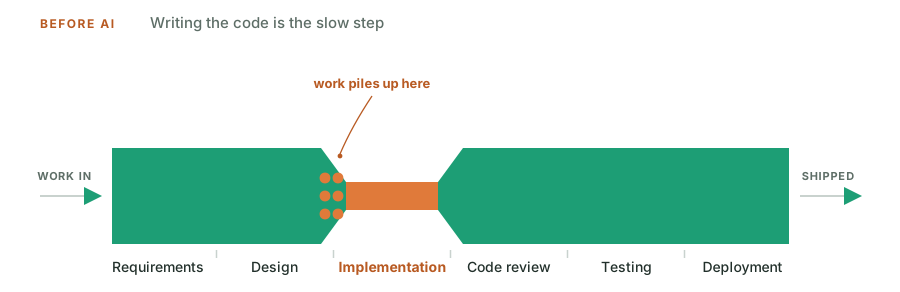
Now that AI has sped up the coding step, it might feel natural to assume that the whole software pipeline would get that much faster too, but in reality it doesn’t. The code is reaching the next step in the process faster, and now that step can’t keep up and becomes the new limiting factor.
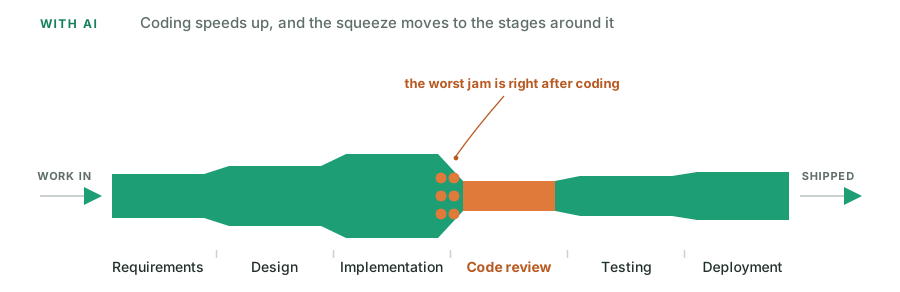
It’s not that these new bottlenecks have gotten slower since the advent of AI-assisted development. It’s just that development used to be so slow that it didn’t matter if they were.
What to Do About Your Bottlenecks
Below are a few general recommendations for how to approach this problem once you’ve recognized it.
Find Where Work is Piling Up
You don’t need a formal value-stream mapping exercise to find your bottlenecks. Just look at where things are stuck. If you have eight pull requests open and the oldest one has been waiting nine days, you’ve found it. A pile always forms right in front of the slow step. Keep in mind, though, that your bottleneck might be BEFORE development in your process, such as requirements gathering. In these cases, there won’t be a pileup of work, but there will be other signs, such as developers needing to ask too many questions or nail down constraints that should have already been ready to go for them.
Resist The Urge To Speed Up The Fast Part
Because coding is the step developers now know how to accelerate, it feels productive to try to just muscle through the other slowdowns and keep the focus on making the coding faster. But pushing more generated code into a review process that’s already saturated doesn’t accomplish anything. In fact, it puts more pressure on reviewers to wave things through too quickly, which is how you end up shipping AI-generated slop.
Put The Effort Into The Slow Step
Depending on where your slowdown is, put all your effort there. Even if you know there will just be another bottleneck at the next step, focus on one problem at a time. Once you clear up the logjam in one place, then you can focus on where the work gets stuck in the next step. It’s not uncommon for this area to be one you’ve been avoiding because it isn’t the fun part. It might be the test automation you keep meaning to write or the CI/CD cleanup that’s been on the “someday” list for three years. Note that these changes often don’t feel urgent or fun, which is exactly why they’re still the bottleneck.
Rinse and Repeat
Fixing one bottleneck doesn’t mean you’ll immediately ship faster. It often just relocates the bottleneck to another stage of your process. Teams that stay fast treat this as a continuous improvement loop, not a one-time fix.
Practical Ideas for Each SDLC Stage
Which stage becomes your bottleneck will vary by team, but it’s usually one of the five below. Once you’ve found where the work is piling up, here are concrete tactics, and some specific tools, for the most common culprits.
Code Reviews
When developers start opening up three times the pull requests they used to, reviewers become the choke point almost immediately, and review done in a hurry encourages AI slop.
- Keep pull requests small - Review quality falls off fast once a change runs past a few hundred lines or an hour of attention, so stay well under that. If AI helped you generate a big change, split it into a stack of small, reviewable PRs with a tool like Graphite.
- Put an LLM reviewer on the first pass - Tools like CodeRabbit, Greptile, and GitHub Copilot’s PR review summarize the diff and catch the obvious problems, so your people spend their attention on design and security instead of style. Push the mechanical checks (formatting, linting, type checks) into CI with pre-commit hooks or SonarQube.
- Scrutinize AI-generated code harder - AI is confident even when it’s wrong, so aim human review at the parts that matter: security, edge cases, and whether the change actually solves the original problem.
Testing and QA
More code means more surface area and more ways to break. If your QA kept pace when features arrived slowly, you’ll need to find a way to accelerate it without overlooking issues.
- Build a regression net that scales with code, not people - A reliable automated suite is what lets you move fast without breaking what you already shipped. Let AI help you build it: Copilot is good at drafting scaffolding and edge cases, and dedicated test-generation tools like Qodo Cover (multi-language), IntelliTest (.NET, in Visual Studio Enterprise), and Symflower (Java and Go) can generate whole suites to push up coverage. Just read what they produce, because tests that only echo current behavior pass forever and catch nothing.
- Kill flaky tests automatically - One randomly failing test teaches everyone to ignore red builds. Detect and quarantine them with Trunk Flaky Tests or your CI’s flaky-test tooling instead of letting them rot.
- Keep the suite fast and prove it catches bugs - Slow tests get skipped locally, which reinvites the backup, so parallelize and lean on fast, reliable end-to-end tools like Playwright. Then use mutation testing (Stryker) to confirm your tests actually fail when the code breaks, since a green suite that never catches a real bug just gives you false confidence.
Requirements and Planning
AI will build the wrong thing just as fast as the right one, so it’s critical that you can quickly and clearly decide what to build.
- Shorten the distance between the decision-maker and the keyboard - If a developer waits two weeks for an answer, AI just means they build the wrong thing faster. Someone with the authority to decide needs to be reachable in minutes or hours.
- Make “done” concrete with examples - When the target is vague, AI will confidently build the wrong interpretation, and you won’t find out until review. A worked example of the expected behavior removes that ambiguity, and specification-by-example frameworks like Cucumber (or Reqnroll on .NET) turn those examples into executable acceptance tests.
- Prototype to decide, then throw it away - AI makes a working throwaway cheap. Use something like v0 or bolt.new to answer a design question in an afternoon instead of debating it for two weeks.
Deployment and Release
A manual and ceremony-heavy release process that previously handled a single deployment per week can buckle when the team wants to ship faster.
- Automate the whole path to production - If shipping depends on a person clicking through a runbook, that person is the bottleneck. Move build, test, and deploy into a pipeline like GitHub Actions or Azure Pipelines, and adopt trunk-based development so releases stay small.
- Separate deploy from release with feature flags - Ship code to production turned off, then turn it on when the business is ready. LaunchDarkly, open-source Unleash, or the vendor-neutral OpenFeature standard all handle this, and it’s the single change that unblocks most teams stuck behind coordinated releases.
- Make rollback boring - Progressive delivery tools like Argo Rollouts and Flagger give you canary and blue-green deploys with automatic rollback, so a bad release is cheap to undo.
Integration and Environments
More code moving through the pipeline multiplies every bit of friction in your environments, so being able to reproduce them quickly can save you.
- Define environments as code - Hand-built staging drifts and breaks. Terraform, Pulumi, or Azure Bicep make environments reproducible and quick to stand back up.
- Give every pull request its own environment - On-demand preview environments let people test in isolation instead of fighting over one flaky shared staging box, and Dev Containers keep each developer’s local setup identical to CI.
- Make builds fast and cacheable - A slow build taxes every single change. Remote caching and task orchestration with Turborepo, Nx, or Bazel keep the pipeline from becoming the thing everyone waits on.
Conclusion
I don’t mean that using AI isn’t worth it, because it is. Just be aware that the speed you gain from it is only as valuable as your ability to absorb that speed throughout your entire process. The teams that pull ahead in the AI era won’t be the ones generating the most code, but the ones who keep finding their real bottleneck, fixing it, and then doing it again.
At Trailhead, we know how to accelerate the entire SDLC with AI because that’s what we do every day with our client projects. One of the best ways to learn it from us is to work with us on a real project. So if you have some software work you’d like to accelerate, get in touch and we’ll help you find where your bottlenecks are and fix them.