Have you ever maintained a software application where a change to one feature almost always broke another feature elsewhere in the application? Or have you ever tried to make a simple change to your software only to realize that it required you to update 10 or more files to accomplish it?
These are common frustrations in the world of software development, especially in large enterprise applications where maintaining and updating code can become a complex and error-prone task. The root of these problems often lies in how our codebases are organized. Traditional layered architectures can lead to tight coupling and interdependencies, making it difficult to implement changes without unintended consequences.
In this blog, I’ll show you how Vertical Slice Architecture (VSA) offers a way to organize your code that minimizes these issues, making it easier to manage, understand, and modify without fear of breaking unrelated parts of your application.
Coupling and Cohesion
Before we can dive into the specifics of VSA, it’s important to understand two fundamental concepts in software design: coupling and cohesion. These concepts are crucial for grasping why VSA is so effective at reducing complexity and enhancing maintainability.
Coupling refers to the degree of direct interdependence between different modules or components in a system. High coupling means that changes in one module are likely to affect other modules, leading to a fragile codebase where a small change can cause a ripple effect of issues. This makes the system hard to understand, test, and maintain. Ideally, we strive for low coupling, where each module operates independently and changes in one do not necessitate changes in others.
Cohesion, on the other hand, measures how closely related and focused the responsibilities of a single module are. High cohesion within a module means its components are highly related and work together to fulfill a single purpose. This makes the module easier to maintain, understand, and test. Low cohesion can result in modules that are a mix of unrelated functionalities, making them confusing and difficult to manage.
By aiming for low coupling and high cohesion, we can create a codebase that is more modular, maintainable, and scalable. Let’s look at how coupling and cohesion are impacted by the way we typically organize our code.
How Code Is Typically Organized
Traditional layered architectures, such as Onion, Clean, and Hexagonal, have been widely adopted to address the principle of separation of concerns. They organize code into distinct technical layers, each with a specific responsibility, such as presentation, business logic, and data access. This separation aims to improve the modularity and maintainability of the codebase.

Onion Architecture, for example, emphasizes keeping the core of the application independent from external concerns by placing the business logic at the center and surrounding it with layers for interfaces and infrastructure. Clean Architecture, similarly, focuses on maintaining a clear separation between the domain and external systems, with a strong emphasis on dependency inversion. Hexagonal Architecture (or Ports and Adapters) aims to decouple the core logic from external systems by using ports and adapters, ensuring that the business logic remains unaffected by changes in external components.
In traditional layered architectures, code is organized into separate layers like presentation, business logic, and data access. Each layer has a specific responsibility, which makes the layers easier to understand and maintain individually. However, this separation also means that even a simple feature change can require updates to multiple layers. For example, a change to a business rule might need updates in the business logic layer, data access layer, and presentation layer. This leads to tight coupling, where changes in one layer often affect others, making it hard to modify the application without causing issues elsewhere. In other words, the cohesion is within technical layers rather than within features.
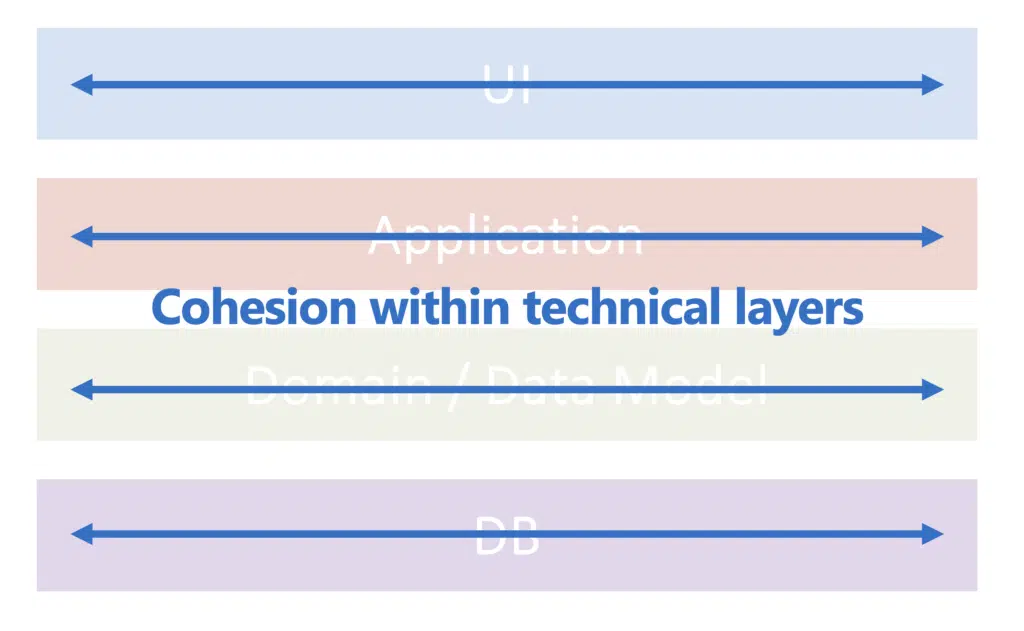
As features are implemented, different layers need to interact with each other. This interaction often leads to code-sharing and dependencies between layers, which can create tight coupling across layers of the application. A change in the data access layer might require updates in the business logic layer, which in turn might impact the presentation layer. This interconnectedness can make it difficult to modify one part of the application without unintentionally affecting others.
As features evolve, shared code tends to proliferate across the layers. This increases the coupling between different features, making it challenging to change or extend one feature without risking side effects in another. For instance, a simple change in a business rule might require adjustments in multiple places, leading to a higher risk of bugs and increased testing effort.
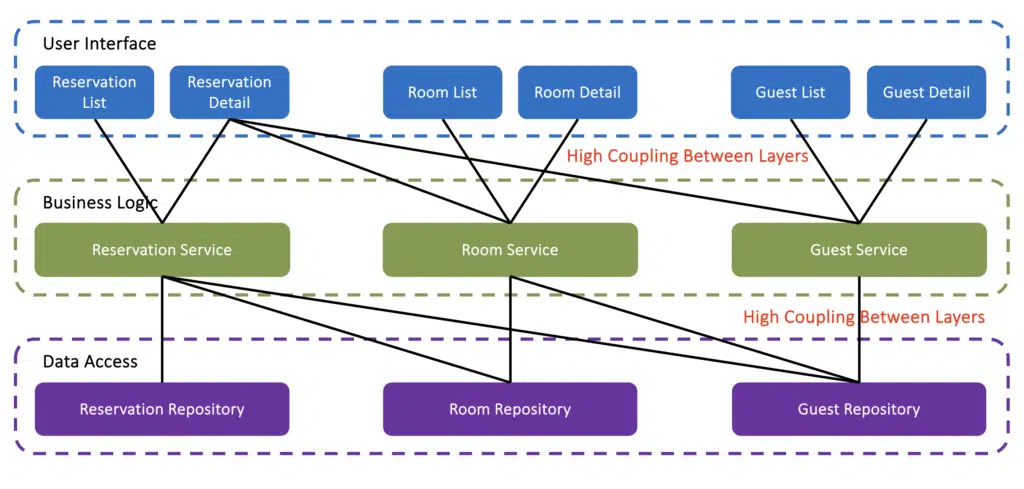
As you can see, these traditional layered approaches, while effective in some ways, can ultimately lead to a situation where the separation of concerns is compromised by the necessity of cross-layer interactions.
This is where VSA provides a significant advantage. By organizing the codebase around vertical slices of functionality—each encompassing all necessary technical layers for a specific feature—VSA reduces the risk of coupling between features and enhances cohesion within each slice. This results in a more modular and adaptable codebase, where changes can be made with confidence and minimal impact on unrelated parts of the application. In the next section, we’ll delve into how VSA can transform your development process by addressing these issues and providing a more effective approach to organizing your code.
Vertical Slice Architecture
Vertical Slice Architecture (VSA) is an approach to organizing software where each feature or functionality of the application is developed as an independent, self-contained slice. Unlike traditional layered architectures, where the code is divided into horizontal layers with particular technical concerns (e.g., presentation, business logic, data access), VSA structures the application around vertical slices of functionality that encompass all the necessary components (UI, business logic, data access, etc.) required to implement a particular feature.
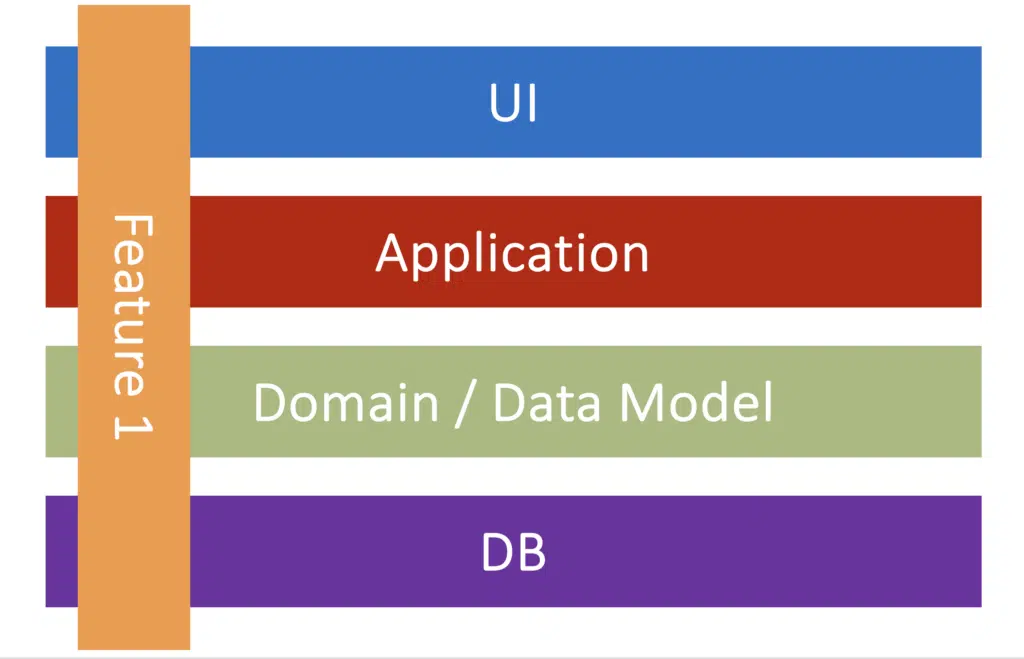
In VSA, each slice is a fully functional unit representing a specific feature or use case. Each slice is built to handle a specific feature or use case end-to-end. This means that all the code necessary to implement and support that feature resides within the slice. Each slice contains all necessary layers, including user interface elements, business logic, and data access. This self-contained nature ensures that changes within a slice are isolated from other slices. Slices operate independently of one another, reducing dependencies and interactions between different parts of the application. This independence makes it easier to manage and update individual features without affecting others.
VSA enhances cohesion by ensuring that all the code related to a specific feature is grouped together in one slice. Each slice has a single responsibility and focuses on a specific functionality, making the code within each slice highly related and easier to understand, maintain, and test.
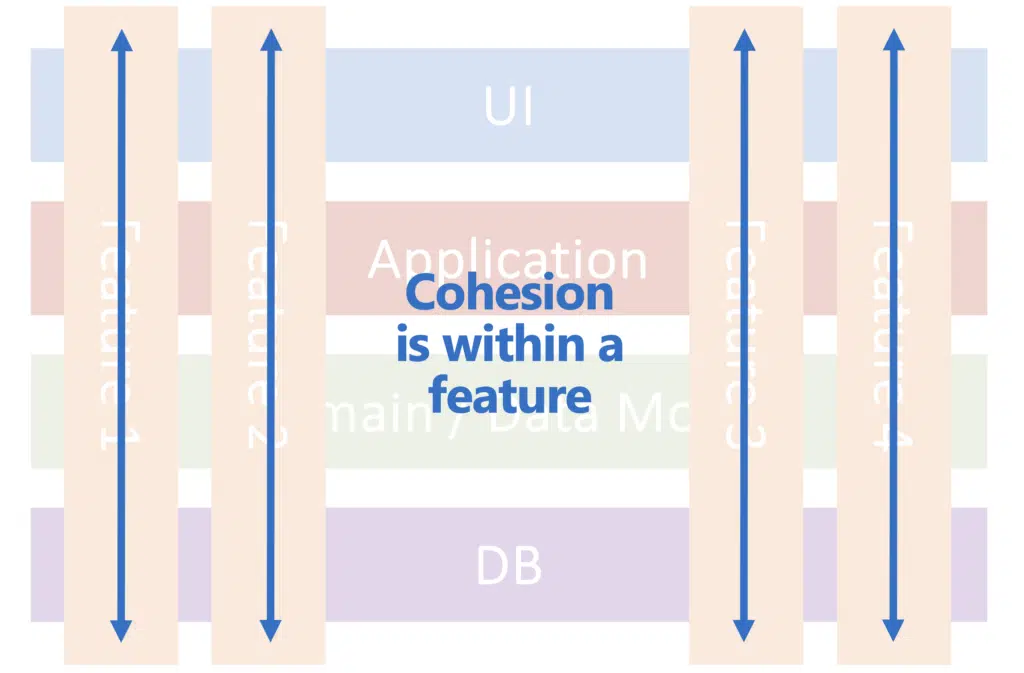
VSA also minimizes coupling by keeping each feature self-contained. Since each slice contains all the necessary components for a feature, there are fewer dependencies between slices. This means that changes to one feature are less likely to impact other features, reducing the risk of unintended side effects and making the codebase more resilient to changes.
Code Organized For Change
One of the key benefits of VSA is that it organizes the codebase around the most common type of change: changes to a specific feature. Here’s how VSA simplifies this process:
- Localized Changes: When you need to modify a feature, you only need to update the code within the corresponding slice. This localization of changes makes it easier to implement, test, and deploy updates.
- Reduced Risk: By isolating changes to a specific slice, the risk of inadvertently affecting other parts of the application is minimized. This results in fewer bugs and more stable deployments.
- Improved Maintainability: With all related code for a feature in one place, developers can quickly understand and navigate the codebase, leading to faster and more efficient development cycles.
- Parallel Development: Multiple developers or teams can work on different slices simultaneously without interfering with each other, enhancing productivity and collaboration.
Conclusion
In summary, Vertical Slice Architecture addresses the challenges of traditional layered architectures by enhancing cohesion within slices and minimizing coupling between them. By organizing the code around features, VSA provides a more modular, maintainable, and adaptable approach to software development. This structure ensures that changes are easier to implement and less likely to cause unintended side effects, ultimately leading to a more robust and maintainable application.
If you’re a .NET developer, I’ve created a sample project showing how you might organize .NET API code by feature. If you’d like help setting up your application for easier change using Vertical Slice Architecture or need to migrate an existing project, contact us to find out how Trailhead can help.